
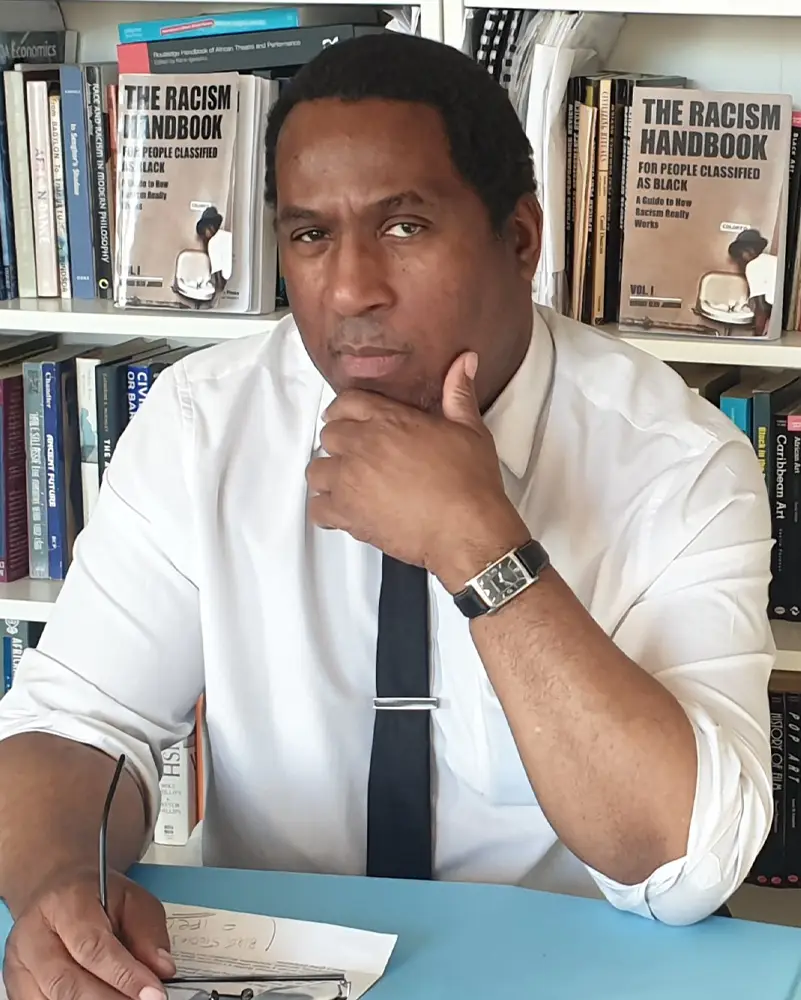
About the author
Johnson is a secondary school qualified English teacher. He is also an
author and academic with over 30 years of knowledge and experience in race and racism and Black Studies (Africana Studies). The author of this handbook is engaged in community anti-racism to help repair the damage of the colonial legacies. His race and Black Studies education began in the 1980s studying the books: Black People in The British Empire, Malcom X and Afro-American History and The Souls of Black Folks. Later, intensive studies of the lectures and books of Dr Amos Wilson, Dr Frances Cress Welsing, and Prof. Charles Mills, Prof. David Gillborn, Prof. Derrick Bell, Prof. Tommy Curry, Dr Frantz Fanon, and Prof. Frank B. Wilderson III. In the early 1980s, in the family tradition, he became a musician and music composer. In 2003, he graduated from the University of Surrey receiving his BMus Honours in Music. Since the 2000s, Johnson has been active in the black community for over 20 years. In 2015, he studied ‘Whiteness Studies’ at University College, London. He presently teaches GCSE English literature and language in a secondary school, and has been teaching the subject since 2004. As a social justice advocate, Johnson is deeply committed to teaching the centrality of race to the making of the modern world. He therefore promotes what he calls ‘racial literacy’ or ‘race education’.
Below is selection of books from Johnson’s library.
‘The history of this book comes from years of an intuitive feeling that in general, most ‘black’ people do not really understand ‘race’ and racism properly – with a suspicion that most ‘white’ people do’
Spread The Word
This Work Needs to be Read
This important work was created by Johnson and has been seven years in the making. This handbook (volume 1) first began as an article written in 2015 called ‘Darwin on Race’ which is considerably different to the chapter in the Handbook of the same name. Johnson wrote fifteen pages and presented it for a possible place on a Ph.D. programme.
I knew exactly what direction, tone and style the writing would take if I signed up. Later I decided to write a Handbook ‘specifically tailored’ for ‘black’ people without being told how it should be written – or what should or should not be included in the book. Also, to be completely free from any influence of ‘white’ lecturers. I say ‘white’ lecturers because this is the reality in British universities and the subsequent push-back they receive with ‘Why is my Curriculum White’ debates.
